
Lufthaven
Lufthaven clone · Travel app · from our videos on X
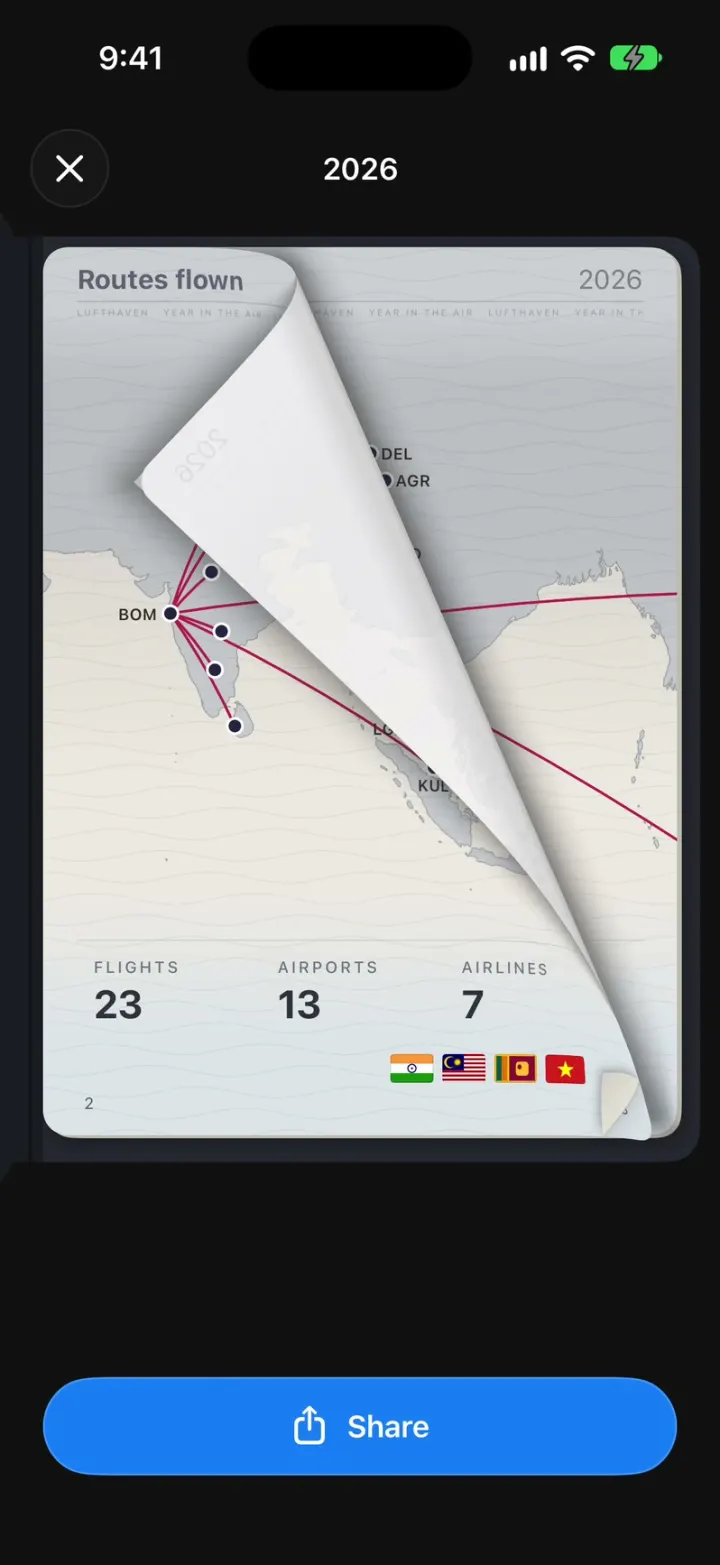
Lufthaven turns your flight log into a passport. The profile shows the year's stats (23 flights, 30,561 km, 13 airports, 7 airlines), the flight list, and a navy passport with a gold-foil map and emblem next to a passport card. Tap the passport and it flies up to fill the screen, then the cover swings open like a real book. Every page is a printed map of the routes you flew on security paper, and you turn pages with a real paper curl, from 'Routes flown' to 'Asia' and back. Tap X and the cover shuts and the passport shrinks back into the profile.
- iPhone · Swift
- Built in 1 prompt
- Free to remix
Remix copies the working app into your account for free, exactly as we built it. It runs in Vibecode's cloud iOS simulator, in your browser.
Watch the video on X@ios_app_builder · Nov 23, 2026The prompt that builds it
We built Lufthaven in one prompt. Paste it into a new app to build your own copy, or change it first.
Prompt · 1,987 words
[image attached][image attached][image attached][image attached][image attached][image attached][image attached][image attached][image attached][image attached][image attached][image attached]
Download/reference the app shown in this post and clone it exactly, including the visual design, layout, interactions, animations, typography, spacing, and all visible states. Make it functional and runnable in the simulator. Match the reference as closely as possible and include any interaction shown in the source. Reference: https://x.com/Starcommander10/status/2124524256516325721. The attached screenshots are frames of the actual 18-second iPhone screen recording (1206x2622, shown at 603x1311) plus three full-resolution close-ups (the profile's passport + passport card, the passport cover, the page header and map), in time order. Inspect them carefully.

Build a native SwiftUI iOS app named Lufthaven using Opus 5.5. Lufthaven is a flight log whose profile shows your year in the air as a physical passport: tap the passport and it flies up, the cover swings open like a real book, and each page is a printed map of the routes you flew that you turn with a real paper page curl. Do NOT put a fake handset frame inside the app; the simulator provides that. No permissions, no backend, no onboarding, no sign-in: the app opens straight onto the Profile tab with this fixture data.

Observed video sequence (0-18.2 s): 0.0-0.8 s the dark Profile screen at rest. 0.8 s tap on the passport. 0.8-1.25 s the passport lifts out of the profile and flies to the centre while growing into the big closed passport; the profile fades to near-black and the top bar (round X button left, "2026" centred) and the blue "Share" button fade in. 1.25-1.5 s the cover swings open around its LEFT edge (it turns toward the viewer and folds away to the left, going edge-on at ~1.4 s), revealing page "Routes flown" (page 2), which starts shaded ~35% darker and brightens to full by ~1.9 s. 2.2-2.7 s a finger drags the page's right edge to the left: the native UIKit page curl lifts the page, showing page 3 underneath. 2.7-4.0 s dragged from the bottom-right corner the curl grows diagonally, then is dragged back and the page lies flat again. 4.2-5.2 s the curl completes: page 2 sweeps away to the left and page 3 "Asia" lies flat. 5.2-9.0 s Asia held. 9.0-10.6 s dragging from the left edge curls page 2 partly back over Asia, then lets it fall away again. 12.6-13.0 s page 2 curls back in from the left and covers Asia: "Routes flown" again. 15.0 s tap X. 15.0-15.7 s the cover swings back shut from the left over page 2. 15.7-16.3 s the closed passport shrinks back into its spot on the profile while the profile fades back in. 16.3-18.2 s Profile at rest.

PROFILE SCREEN (screen 402x874 pt; background #0F0F0F; everything white/grey on black; SF Pro):
- Round avatar 88 pt, fill #1C1C1C, white bold "M" (40 pt), centred at (201, 118). Settings button top-right: 48 pt circle #161616 with a 1 pt #2A2A2A border and a white gearshape icon, centre (358, 98).
- "Maya Lindqvist" bold 28 pt white centred (y 187), "@mayaflies" 17 pt #8E8E93 (y 214), "0 followers · 0 following" 17 pt #8E8E93 (y 237).
- Hero (y 262-472): the closed passport on the left (about 145x210 pt, x 64-218), standing with a slight 3D turn (its right edge further away, rotation3DEffect ~-12° about Y) and a soft drop shadow; overlapping it in front on the right, the Passport Card (about 160x112 pt, x 175-336, y 323-433, rotated ~+3°, corner radius 8, soft shadow). Tapping the passport opens it. The card is decoration.
- Stats row (y ~505): four columns at x 24, 112, 238, 335: big bold white numbers 26 pt "23", "30,561", "13", "7" with grey 15 pt labels under them "flights", "km", "airports", "airlines".
- Segmented control (y ~575): a capsule #181818, x 24-256, height 40, three options "All time", "2026", "2025"; "2026" selected as a white pill with black semibold text, others grey #8E8E93. Tapping works.
- Flight list under it, rows 60 pt with 0.5 pt #212121 dividers: grey date (15 pt, x 24) and to its right (x 84) the route in white semibold 17 pt with an arrow, and below it a 16 pt airline logo square + flight number in grey 15 pt: "31 Oct" "Delhi → Mumbai" "6E 6022" (IndiGo: white square, navy dotted plane mark); "29 Oct" "Mumbai → Delhi" "AI 2952" (Air India: red square, white swoosh); "19 Oct" "Bhopal → Mumbai" "IX 1786" (Air India Express: orange X mark); "15 Oct" "Mumbai → Agra" "AI 2817"; "15 Oct" "Agra → Navi Mumbai" "6E 5104"; then more 2026 rows (Mumbai → Kuala Lumpur, Kuala Lumpur → Kota Kinabalu, Penang → Langkawi, Mumbai → Hanoi, Mumbai → Colombo, Bengaluru → Colombo, Mumbai → Hyderabad...) so the list scrolls.
- Floating tab bar: a dark glass capsule x 61-341, y 778-830, fill #1B1B1B, 1 pt #2C2C2C border, four icons: airplane, person.2.fill, magnifyingglass, person.crop.circle (the last selected, sitting in a lighter #353535 rounded pill). Other tabs can be simple placeholder screens.

THE PASSPORT (cover, see the close-up): deep navy leather #1E2230 with a fine leather-grain noise texture and a faint vertical spine crease ~6% in from the left edge. The top-right region above a diagonal running from the left edge at ~6% height down to the right edge at ~50% height is gold line-art: a polar map graticule (curved latitude arcs and meridians converging toward the top) with the North Atlantic coastlines (Greenland, Iceland, Scandinavia, the British Isles, Western Europe) drawn as gold outlines filled with fine horizontal hatching. Along the diagonal runs a gold "ladder" band (two parallel gold lines ~9 pt apart joined by short cross-rungs). Lower left, gold foil: a winged emblem (an eagle with spread wings under a small rayed sun, wreath below), then the e-passport chip symbol (a small gold rectangle with a dark ring in its middle and a line through it), then "LUFTHAVEN" in a gold classical sans (Optima, ~34 pt in the big view) and "PASSPORT" smaller below it. Gold = foil gradient #E2C36F -> #B8913E. Generate the emblem as a transparent PNG with gpt-image-2.5-flare (run env and use the project's proxied OPENAI_API_KEY with https://api.openai.com/v1/images/generations, background transparent); draw everything else in code. The same cover is used small on the profile and big when open.

PASSPORT CARD (profile only, see the close-up): white-to-lavender card with faint wavy security lines; top-left the gold emblem; centred "Lufthaven" in bold italic blue #3E5FC0 and below it "★ PASSPORT CARD ★" small caps letterspaced with red stars; top-right "Year" tiny grey over "2026" bold; a light-blue (#B9C6DD) world map; red route lines from Mumbai over India and SE Asia; bottom row: four small flags (India, Malaysia, Sri Lanka, Vietnam) and stats "Flights 23", "Distance 30,561 KM", "Airports 13", "Airlines 7".

OPEN PASSPORT SCREEN (same #101010 background):
- Top bar: round close button 44 pt (#161616 fill, 1 pt #2A2A2A border, white xmark) centred at (39, 94); "2026" semibold 17 pt white centred at y 94.
- The open book: behind the page a navy block #26272F (the passport's inside) from x 0 to 391, y 132 to 649, right corners rounded 18 pt; its left 24 pt is the inside of the cover (#1B1C22) with a darker 2 pt vertical binding line at x 17. The page sits on it at x 24-378, y 138-634 (354x496 pt), corner radius 14, faint shadow.
- Bottom: a "Share" button, capsule x 24-378, y 769-824, fill #127AF7 with a 1 pt #3D95FF border, white square.and.arrow.up icon + "Share" semibold 17 pt centred (opens the share sheet with a rendered image of the current page).

PAGES (cream security paper, the core of the look):
- Paper: base #EDE9E1, a soft grey veil over the upper map area fading out downward, and the bottom quarter tinted pale blue-grey (#DCE3E9). Across the whole page faint horizontal guilloche waves (sine lines ~12 pt apart, amplitude ~3 pt, wavelength ~90 pt, black at ~5%).
- Header (inset 19 pt): title bold 15 pt #5E6170 left ("Routes flown" / "Asia"), "2026" regular 15 pt #7B7E86 right, a 0.5 pt #A9ADB3 rule under them, and under the rule a microprint line of 5 pt letterspaced caps #A0A3A8 repeating "LUFTHAVEN   YEAR IN THE AIR   " across the page.
- Map (from y ~10% to ~78% of the page, bleeding to the page's left and right edges): land #CBCED2 with a 0.6 pt #9EA3A8 coastline stroke, sea = the paper. Download Natural Earth 50m land (https://raw.githubusercontent.com/nvkelso/natural-earth-vector/master/geojson/ne_50m_land.geojson) into the workspace, trim it to lon 40..150, lat -25..70, bundle it, and draw it with a Mercator projection in a SwiftUI Canvas (use the 110m file for the passport card's world map and the cover's coastlines). Routes: crimson #B8264A 1.5 pt gently arched lines. Airports: 7 pt #262342 dots with a 1.5 pt white ring. Labels: IATA codes semibold 9 pt #2F2C2A next to the dots.
- Stats block: a 0.5 pt #B7BAB9 rule at ~78% page height; three columns at 8%, 37%, 66% of the page width; labels 9 pt letterspaced caps #6E7280, values bold 22 pt #2D333C. Then a row of small rectangular flags (24x16 pt, radius 2, hairline border). Page number 9 pt #555 at the bottom corner.
- Page 2 "Routes flown": map extent lon 59°E-128°E, lat 17°S-52°N (so BOM sits ~20% from the left and HAN ~67%). Hub BOM (19.09N 72.87E, labelled "BOM") with unlabelled lines to DEL (28.56, 77.10), AGR (27.16, 77.96), BHO (23.29, 77.34), HYD (17.24, 78.43), BLR (13.20, 77.71), CMB (7.18, 79.88); labelled lines BOM-HAN (21.22, 105.81), BOM-KUL (2.75, 101.71); labelled LGK (6.33, 99.73), PEN (5.30, 100.28), KUL, BKI (5.94, 116.05) with lines KUL-LGK, KUL-PEN, PEN-BKI, KUL-BKI. Stats "FLIGHTS" "23", "AIRPORTS" "13", "AIRLINES" "7". Flags right-aligned: India, Malaysia, Sri Lanka, Vietnam. Page number "2" bottom-left. Bottom-right corner: a small static dog-ear (a ~28 pt curled-up corner triangle with a soft shadow) showing the "3" of the next page.
- Page 3 "Asia": map extent lon 58°E-95°E, lat 1°N-37°N. Hub "BOM" with "NMI" (18.99, 73.07) under it, labelled lines to DEL, AGR, BHO, HYD, BLR, CMB, plus BLR-CMB, and the HAN and KUL lines running off the right edge. Stats "IN ASIA" "19 flights", "AIRPORTS" "8", "BORDERS" "6". Flags left-aligned: India, Sri Lanka. Page number "3" bottom-right. No dog-ear.

INTERACTIONS (native feel, never static screenshots):
- Open: tapping the profile passport runs a hero transition (matchedGeometryEffect or a frame-interpolated overlay): 0.45 s spring, from its small tilted spot on the profile to the full book rect (x 24-378, y 138-634, the 3D tilt easing to flat), while the profile fades to black and the top bar and Share fade in. Immediately after, the cover swings open: rotation3DEffect about the Y axis anchored on its LEADING (left) edge, 0 to -100 degrees with perspective ~0.5, 0.3 s easeIn, so it turns toward the viewer and folds off to the left, revealing page 2 under a 35% black shade that fades out over 0.4 s.
- Pages: a UIPageViewController with transitionStyle .pageCurl (spineLocation .min, single-sided), wrapped in UIViewControllerRepresentable, so drags give the real interactive paper curl with the translucent back side, from the right edge or bottom-right corner forward and from the left edge back. Two pages: Routes flown, Asia.
- Close: X swings the cover back shut over the current page (reverse of the open, 0.3 s easeOut), then the closed passport shrinks back into its profile spot (0.45 s spring) while the profile fades in. Opening again always starts on page 2.
- Every launch starts on the Profile tab scrolled to the top, passport closed.

Build fully, run compile/build validation, resolve all errors, and launch in the web simulator. Prioritize fidelity to the attached screenshots and the main flow (tap passport -> flies up -> cover swings open -> page curl between the two map pages -> X closes it back into the profile). Deliver complete implementation rather than a plan.
More templates
All templates- View template
Google Maps Clone
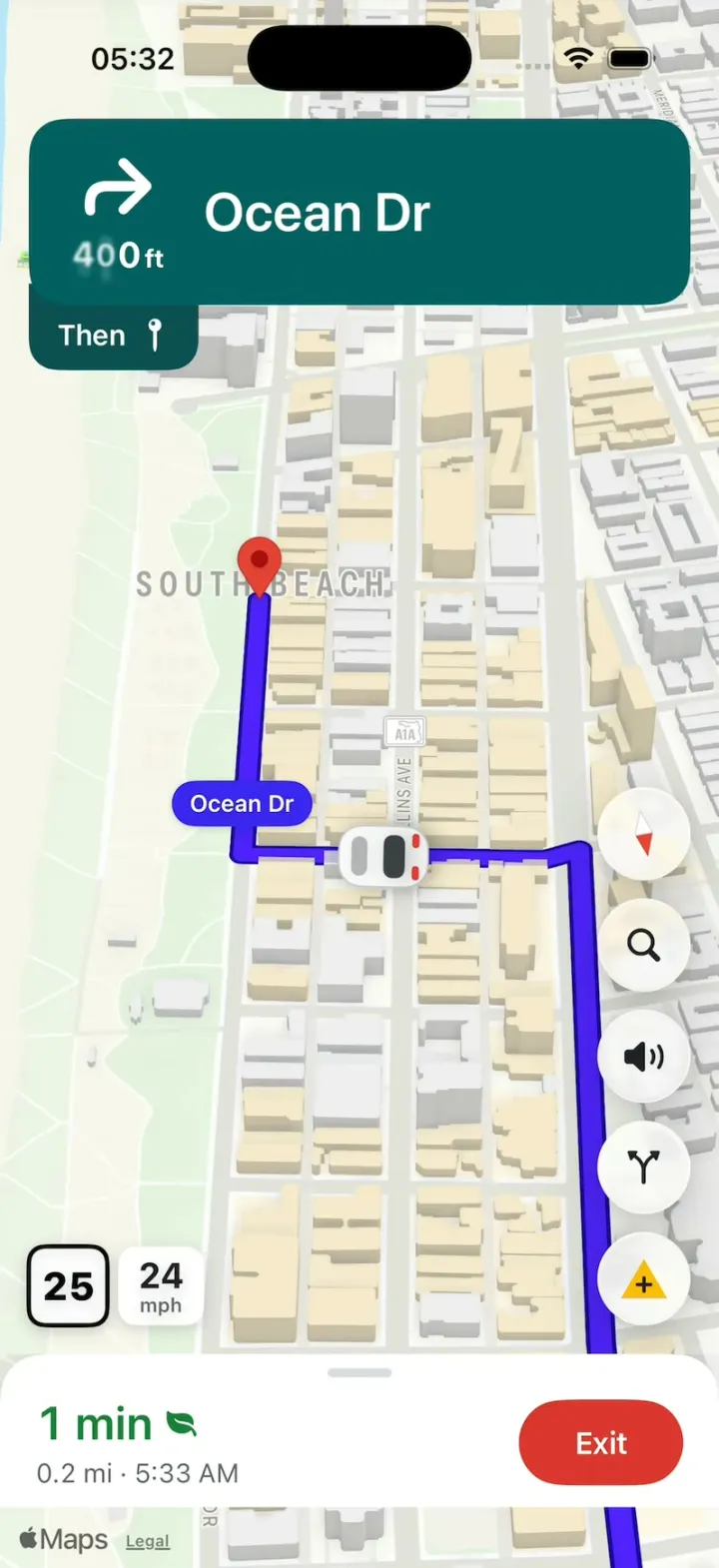
iOSA Google Maps-style app: search, place pages with Popular times, route options and turn-by-turn navigation.
- View template
Next Stop
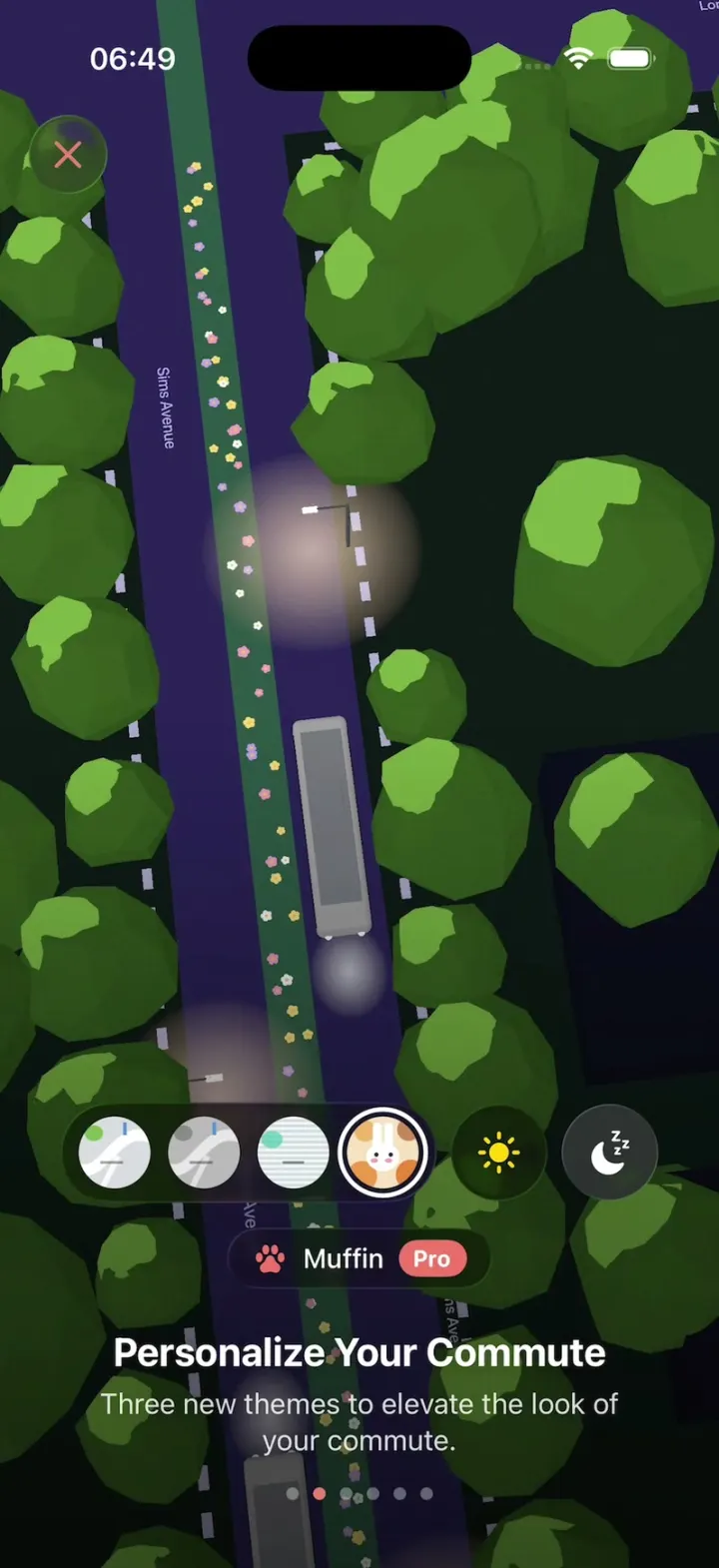
iOSA bus app onboarding over a live 3D night street: swap map themes, ring the bell, unfold a handwritten letter.
- View template
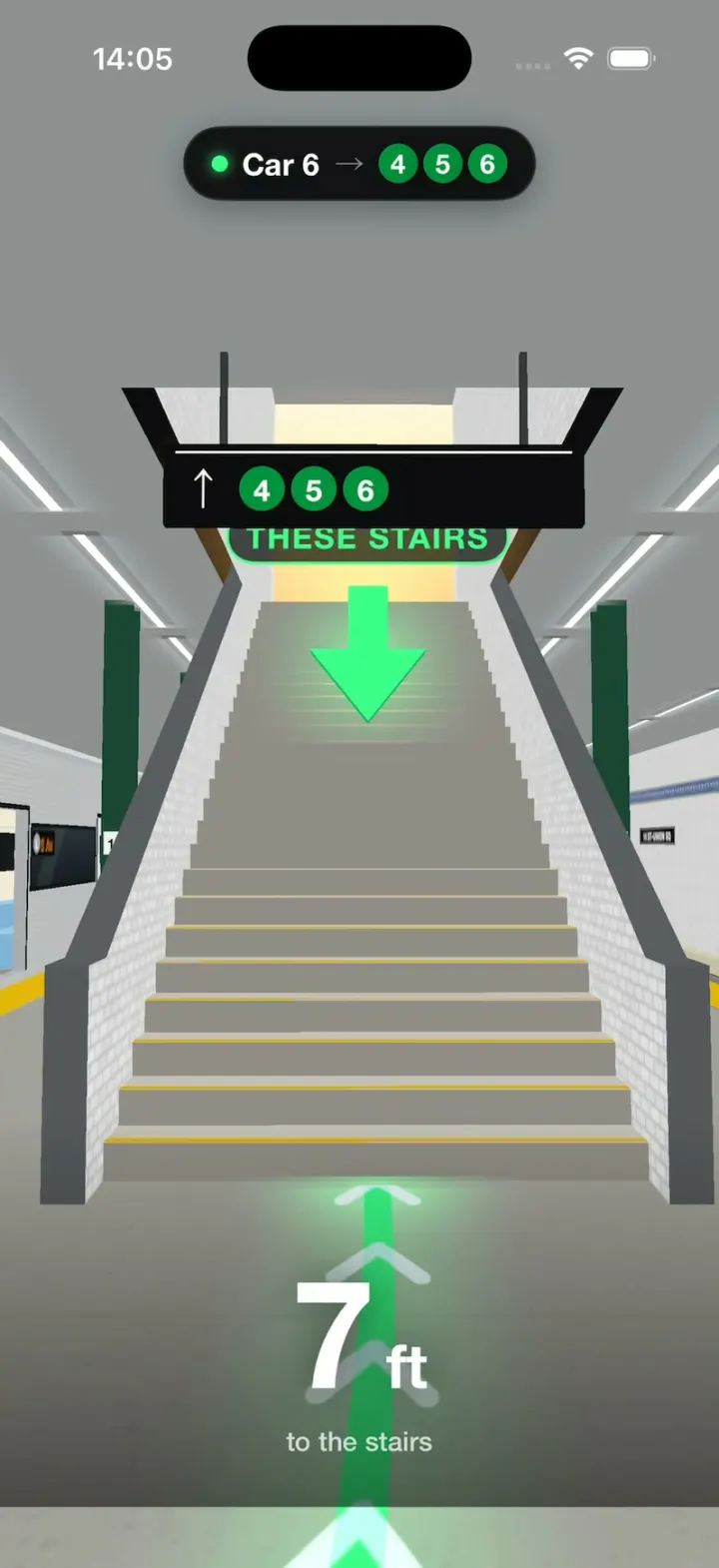
Which Stairs
iOS3D NYC subway directions: see which car to board and which stairs to take before you get there.
- View template
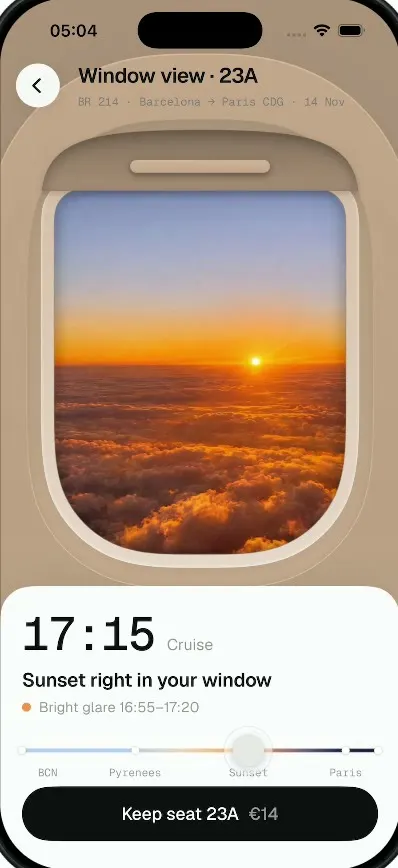
Window Seat
iOSTap a window seat and see your real view out of it, from takeoff to landing, before you pay for it.