

Table of contents
- Can I vibe code if I can't code?
- What you need to start vibe coding
- A real test: one line in, one app out
- What can you vibe code?
- What's still hard to vibe code
- Can I vibe code on my phone?
- Can I vibe code for free?
- How long does it take to vibe code an app?
- Should you vibe code your idea?
- Frequently asked questions
TL;DR
- Yes. If you can describe an app in plain English and say what's wrong when you try it, you can vibe code.
- We sent one checker-written prompt to Vibecode and had a working dog adoption iPhone app in 9 minutes and 34 seconds, for $3.69 in credits.
- The first build is free for new accounts that sign up with Google or Apple on the web or the iPhone app, plans start at $20 a month, and Apple charges $99 a year to publish an iPhone app.
- Live multiplayer, paying people out and licensed content are the hard parts.
Yes, you can vibe code, even if you have never written a line of code. Vibe coding means you describe the app you want in plain English. An AI agent writes the code and runs the app. Then you try it and say what to change. If you can explain what you want and notice what's wrong, you have the skills it takes.
Most people who ask "can I vibe code?" want to know if someone like them can do it and what it costs. This guide answers both with a real test from a one-line idea, then covers what you can and can't build, as of October 2026. Have a specific idea already? Our free Can I vibe code it? checker tells you in seconds which parts are easy, which need setup and what to build first.
Can I vibe code if I can't code?
Yes. Vibe coding moves the work from writing code to describing and testing. Here is what you do:
- Describe the app: who it's for, what the main screen shows, what a tap does and how it looks.
- Try what the agent builds, in a live preview in your browser or on your phone.
- Say what to change, one thing at a time, in plain words.
The agent does the rest. In Vibecode, it writes the code, builds the app, then opens it and taps through what it changed. It fixes what breaks, then tells you what it couldn't fix or check.
Two habits help a lot. Be specific: "make the add button bigger and green" works better than "make it better". And expect a few rounds, the same way you'd give notes to a designer. You don't need to read code, own a Mac, install Xcode or get API keys. You can describe your first app right now.
What you need to start vibe coding
| You need | Why | Cost |
|---|---|---|
| An idea with one main job | A focused first version comes out better | Free |
| A computer or a phone | Vibecode runs in a browser and in its phone apps | One you have |
| A tool that builds and runs the app | It writes the code, runs the app and fixes errors for you | Free first build, then from $20 a month |
| An hour or so | Enough for a first version you can tap through | Your time |
| Apple's Developer Program, later | Only to put a native app on your iPhone or in the App Store | $99 a year |
The first four get you a working app you can try in your browser or in the Vibecode phone app. Apple's program only matters when you want to install it on your own iPhone or publish it.
Check your idea for freeA real test: one line in, one app out
To test it, we typed one line into our free Can I vibe code it? checker: "A Tinder-style app for adopting shelter dogs near me." It answered "Mostly yes", with a vibe score of 84. Swipe cards, dog profiles, a nearby search and favorites work out of the box. Real shelter listings and adoption forms need more setup.
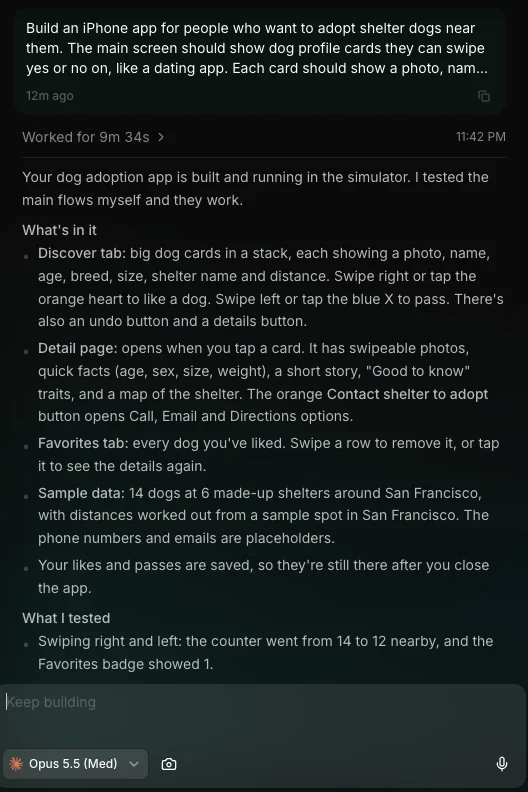
The checker also wrote a 102-word first prompt. On October 20, 2026, we pasted it into Vibecode as a new native iPhone app, word for word, and sent it as one message:
The checker's first prompt, sent as is · 102 words
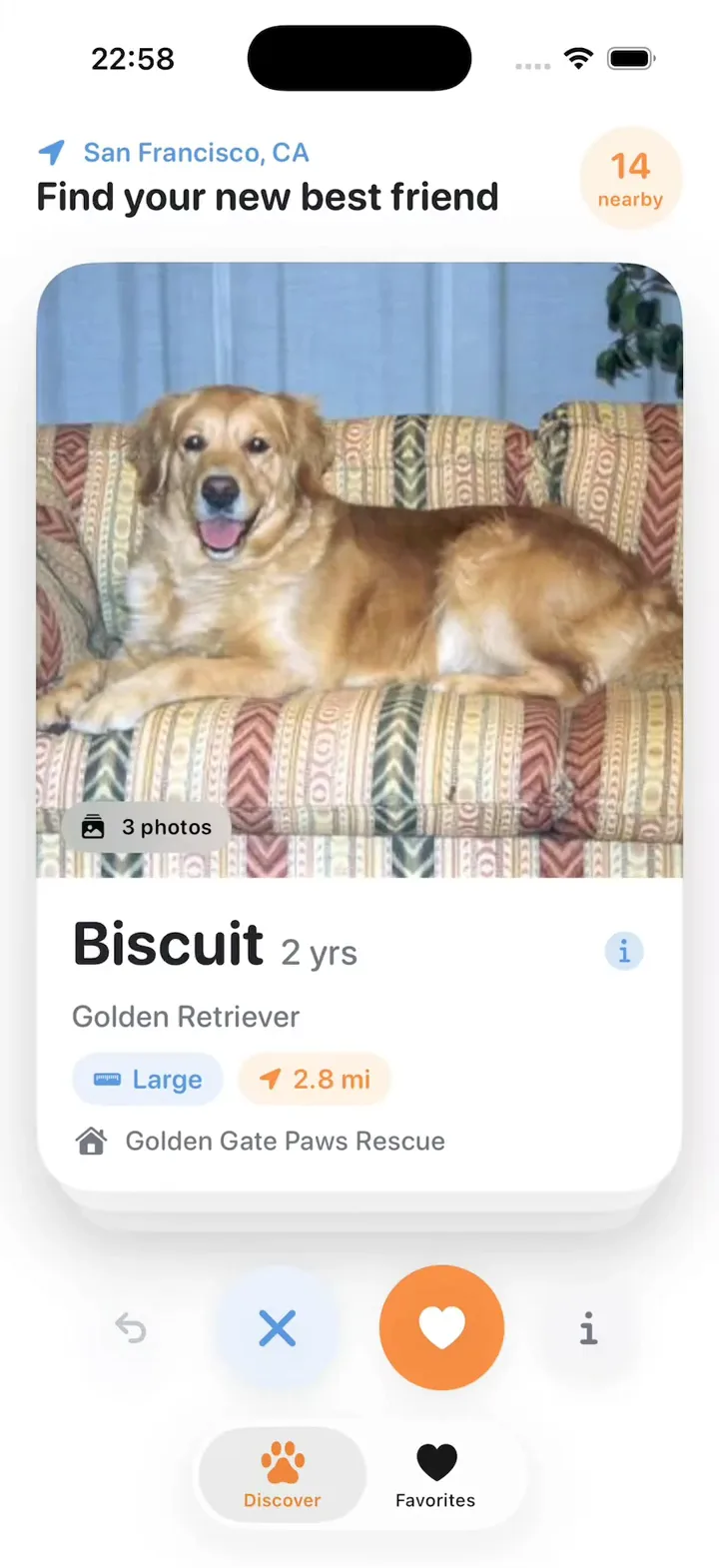
Build an iPhone app for people who want to adopt shelter dogs near them. The main screen should show dog profile cards they can swipe yes or no on, like a dating app. Each card should show a photo, name, age, breed, size, shelter name, and distance from the user. Tapping a card should open a simple detail page with more photos, a short story, and an adoption contact button. Use a warm, friendly look with white backgrounds, soft blue and orange accents, and large photo cards. Please use realistic sample dog data and sample nearby shelter locations for the first version.
Nine minutes and 34 seconds later, PawSwipe was running in the simulator. The agent also tested the main flows itself before it said it was done.
You swipe right to like a dog, and an "Adopt me" stamp follows your finger. Each dog has a page with photos, a short story, a few facts and a map to its shelter. The "Contact shelter to adopt" button opens call, email and directions, and liked dogs go to Favorites.
It cost $2.68 in AI credits, plus $1.01 of simulator and build time, so $3.69 in all. We ran it on a paid account with Claude Opus 5.5, the default for a new app's first build. A new account's free first build runs on GPT-6.1 Sol and keeps the first version to 3 features, so yours will be smaller.
It wasn't perfect, and the agent said so itself. Its reply warned that a dog's extra photos may show a different dog of the same breed, and that the simulator can't place calls or send emails, so those need a real phone. We also saw a few old, blurry sample photos, a placeholder that flashes before a photo loads, and a dog's name that slides under the status bar when its page scrolls. We didn't fix them for this test. The dogs and shelters are sample data, as the prompt asked. Real listings would need a shelter's data and a database, which is the part the checker flagged as setup.
Want to see what your own idea turns into?
Build your first version freeWhat can you vibe code?
Most apps people want are a set of screens, saved data and a few phone or AI features, like a camera, maps or a chat assistant. That's where vibe coding works best. Here's what's within reach, with real examples built in Vibecode:
| Kind of app | Can you vibe code it? |
|---|---|
| Habit tracker, journal, budget | Yes, like Mochi, a habit tracker with a pet |
| AI chat or photo app | Yes. Our ChatGPT clone shows the look and flow with scripted answers, and real AI answers are paid from your credits |
| 2D or simple 3D game | Yes, like Tilt Kart, a 3D kart racing game |
| Social feed or dating app | Yes. Our Instagram and Tinder clones show the feed and the swipe deck with sample data. Real accounts and saved posts need logins and a database, on Plus and up |
| Booking app or marketplace | Partly. Listings and booking requests that other people see need logins and a database, on Plus and up. Paying people out takes more work. See our Airbnb clone |
| Website or online store | Yes, with your own Stripe account for payments. See how a web app goes live |
Each app above is a real one built in Vibecode, shown with the prompts that built it. Browse more on the templates page. On a new account, build your own idea first, since remixing a template uses up the free first build. For the checker's verdict on more than 250 famous apps, from Instagram and Roblox to business tools like Salesforce and Square, see the full list.
What's still hard to vibe code
Vibe coding has real limits, and it's better to know them before you start:
- Live, many-player features. Multiplayer games, video calls and live driver tracking can work, but they take many rounds of testing.
- Paying other people. Taking payments is setup, on a website or in an app. Paying sellers or drivers out, like Uber or Airbnb do, takes more work.
- Money services and closed systems. Sending money between people, debit cards and real trades go through a licensed partner once it approves your app. Medical records and school systems need their owner's approval. Bank connections through Plaid are setup.
- Content you don't own. You can build a music player in an afternoon. You can't stream famous songs without licenses.
- What phones don't allow. No iPhone app can read your iMessages or WhatsApp chats.
- What Vibecode doesn't build. Mac and TV apps, and browser extensions. A web app runs on any computer, and an Apple Watch app comes as part of an iPhone app.
The rest of the hard part is the last stretch of any app: odd edge cases, Apple's review and real people doing things you didn't expect. Before you submit, read the App Store rejections checklist.
Can I vibe code on my phone?
Yes. With the Vibecode iPhone app or the Android app, you describe an app, watch it build and try it, all on your phone. The iPhone app has been on the App Store since June 17, 2025. As of October 2026 it's rated 4.6 from 3,324 ratings in the US.
Your projects are the same ones you see on the web, so you can start on your phone and finish on a laptop.
Can I vibe code for free?
You can start for free. On Vibecode, a new account's first app build is free when you sign up with Google or Apple and build on the web or in the iPhone app. It has to be your account's first project. Remixing a template first uses it up, so start from your own idea. It runs for up to 10 minutes and makes a first version with up to 3 features. It fills in sample data for parts like AI answers, logins and payments. After a free native iPhone build, you get 2 minutes in the live simulator to try it.
To keep building after that, you need credits, from a paid plan or from auto-reload, which works on the Free plan with a saved card. Logins, a database and App Store submission start on Plus:
- Plus, $20 a month: $20 in credits, logins and a database for your app, and App Store submission.
- Pro, $50 a month: $55 in credits, plus downloading your code.
- Auto-reload: tops up credits when you run low. The smallest reload is $20.
Apple charges $99 a year to install a native app on your own iPhone or to publish it. See every plan on the pricing page, or start your free first build.
How long does it take to vibe code an app?
A first version takes minutes, not weeks. PawSwipe took 9 minutes and 34 seconds from one prompt. In our how-to guide, Mochi's first version was ready 16 minutes and 50 seconds after we pressed send, and four messages took 46 minutes and 47 seconds in all.
An app that's ready for real users takes longer. Each new part, like logins or payments, adds a few more rounds of building and testing. Then Apple reviews it. Apple says it typically reviews at least half of all submissions in under 24 hours and 90% in under 48, on its App Review page.
Should you vibe code your idea?
Here is a quick way to decide:
- Vibe code it if it's a phone app, game, tool or website with one main job, and you want to try it this week.
- Bring in a developer if it moves money, handles medical records or has to serve huge crowds on day one. You can still vibe code the first version to show them.
- Not sure? Type the idea into Can I vibe code it? and see which parts are easy.
When you're ready, describe your app and Vibecode builds the first version. It's free for new accounts that sign up with Google or Apple.
Start building for freeFrequently asked questions
Where can I vibe code?
In your browser at vibecodeapp.com, or in the Vibecode iPhone or Android app. Vibecode writes, runs and tests the whole app for you. If you can read code, coding agents like Claude Code and Cursor work inside a project on your own computer instead.
Can I vibe code with Claude?
Yes. You can run Claude Code yourself with a paid Claude plan or a pay-as-you-go Anthropic API account. Or let Vibecode run it for you. Every build runs Claude Code, Anthropic's coding agent, in a cloud sandbox, and you pick the model for each message from Claude, OpenAI GPT, Google Gemini, Meta Muse, Kimi and GLM models. By default a new app's first build uses Claude Opus 5.5 and later changes use GPT-6.1 Sol. A new account's free first build always runs on GPT-6.1 Sol.
Can I vibe code full stack apps?
Yes. Ask for sign-in and saved data, and Vibecode Cloud adds a backend with a database, user logins and file storage, on the Plus plan and up. A live backend uses one of your plan's included deployments. Plus has 1, Pro has 3 and Max ($200 a month) has 5. If you already use Supabase or Firebase, add your keys and ask the agent to use them instead.
Can I vibe code a website?
Yes. Pick Web app, describe the site, and Vibecode builds it, previews it and deploys it to a yourapp.vibecode.run address or your own domain. Keeping it online takes one of your plan's included deployments or a $20-a-month deployment. Web apps can take payments through Stripe.
Can I vibe code a game?
Yes. 2D games and simple 3D games work well as native Swift iPhone apps. Tilt Kart, a 3D kart racing game, was built in Vibecode, and its template shows the prompt. Games where many people play live at the same time are the hard kind.
Can I vibe code an Android app?
Yes, as a React Native app that runs on iPhone and Android from one codebase. Pick Mobile app (Legacy) when you create a project after signing in. To put it on Google Play, download the code on the Pro plan, then build and publish it yourself with your own Google Play Console account.
Can I sell an app I vibe coded?
Yes. You publish it to the App Store under your own Apple Developer account, and Vibecode's Plus plan includes App Store submission. Apple's rules still apply. Subscriptions and digital goods sold inside an iPhone app use Apple's in-app purchase, through RevenueCat from the Payment tab in a React Native app on Pro. Physical goods and services, like food or bookings, can take card payments through your own Stripe account.
About the editorial team

Vishal is a product engineer at Vibecode. Before Vibecode he did product engineering at EarnIn and co-founded Ivella (YC S21), a banking app for couples. He studied computer science at Duke.
More from the Vibecode blog
Tutorial
How to vibe code
Six steps from an idea to an app on your phone, shown on one real build: every prompt ready to copy, a demo video, screenshots and what each message cost.
Case Study
App Case Study: Daily Grid
Zac Zimmerman always wanted to build a mobile app. The Vibecode Holiday Challenge inspired him to finally build one with the Vibecode App and he finished third out of 49 entries.
New to AI app building? Read what vibe coding means or compare the best AI mobile app builders. Have an idea? See if you can vibe code it.