ChemASAP
Science app · built by the Vibecode team
ChemASAP rebuilds the Baran Lab's paper reader for chemists: one feed of the newest ASAP and early-view papers, each card led by its graphical abstract, with the journal, authors, abstract and Full text, Show abstract and Share buttons. Tap a journal chip (JACS, Angew., Nat. Chem., ChemRxiv and nine more) and the feed switches to that journal under TODAY, YESTERDAY and dated headers. The Journals panel lists 31 journals in five sections with toggles, New pills and impact factors, and ChemRxiv preprints get their own orange-edged cards. Everything runs on local fixture papers with generated graphical abstracts, so no feeds or accounts are needed.
- iPhone · Swift
- Built in 1 prompt
- Free to remix
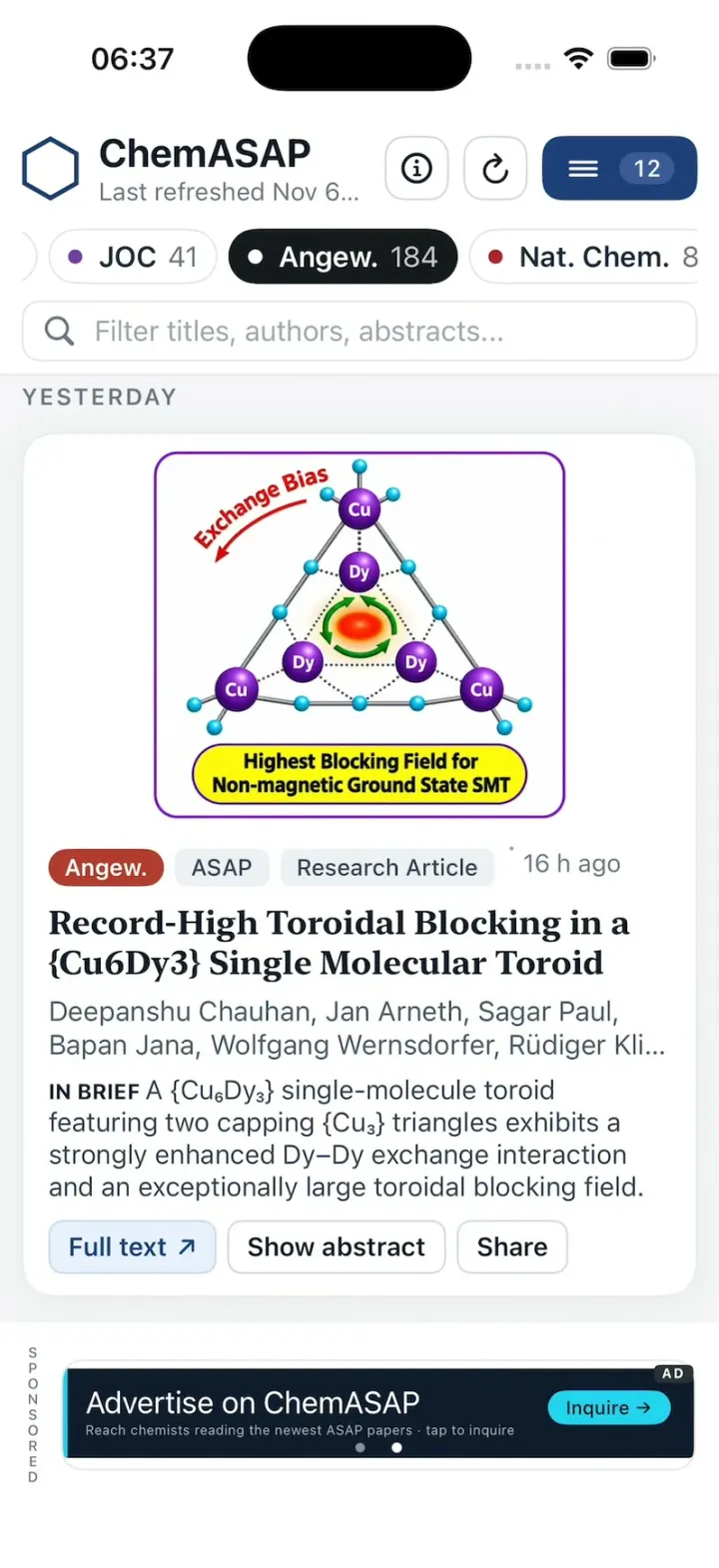
Remix copies the working app into your account for free, exactly as we built it. It runs in Vibecode's cloud iOS simulator, in your browser.
The prompt that builds it
We built ChemASAP in one prompt. Paste it into a new app to build your own copy, or change it first.
Prompt · 3,967 words
[image attached][image attached][image attached][image attached][image attached][image attached][image attached][image attached][image attached][image attached][image attached]
Download/reference the app shown in this post and clone it exactly, including the iPhone visual design, layout, interactions, animations, typography, spacing, and all visible states. Make it functional and runnable in the simulator. Match the reference as closely as possible and include any interaction shown in the source. Reference: https://x.com/BaranLabReads/status/2118847461083210028. The attached screenshots are frames of that 28-second iPhone screen recording (in order: the All feed, Angew. selected, Nat. Chem. selected, the Journals panel top / middle / flagship section / bottom, the chip row mid-scroll, the All feed with the "Advertise on ChemASAP" slide, JACS selected, and the ChemRxiv preprint feed). Look at every one of them before writing code.

Build a native SwiftUI iOS app named ChemASAP using Opus 5.5. ChemASAP is the Baran Lab's free iPhone app for chemists: one feed of the newest ASAP / early-view papers from many publishers, each card led by the paper's graphical abstract (TOC graphic), with journal filter chips across the top and a Journals panel that chooses which journals appear in the feed. Portrait iPhone only, light mode. Do NOT put a fake handset frame inside the actual app; the simulator provides that. Use realistic deterministic fixture data (below) so every screen is rich and usable offline, with no accounts, permissions or network. Do not publish externally.

Observed video sequence (0-28s):
- 0.0-1.1: iOS Home Screen; the ChemASAP icon (white rounded square, a navy hexagon outline, "Chem ASAP" in navy inside it) opens the app.
- 1.1-2.9: the feed. Header, chip row, search field, then "TODAY" and the JOC card. The chip row is already scrolled so "JOC 41" is the first full chip (a sliver of the Org. Lett. chip shows at the left edge), then "Angew. 184", "Nat. Chem. 8", "Nat. C..." cut off at the right edge. "All" is the selected chip (off-screen to the left).
- 2.9: tap "Angew. 184": the chip turns selected (near-black fill) and the feed switches instantly to the Angew. papers, scrolled to the top: date header "YESTERDAY", the Angew. card first.
- 4.75: tap "Nat. Chem. 8": the feed switches to "WEDNESDAY, NOVEMBER 4" and the Nat. Chem. aptamer card.
- 5.0: tap the navy menu button ("≡ 12"): it dims while pressed, and at 5.4 the Journals panel appears with a quick ~0.12 s cross-fade (no slide).
- 6.3-8.8: scroll the Journals list down to the very bottom (Preprints section and the footnote), 8.8-13.3: scroll back up to the top.
- 14.5: tap the X: the panel cross-fades away (~0.12 s); the feed is still on Nat. Chem.
- 15.0-15.8: swipe the chip row right back to its start: "All 743", "JACS 199", "Org. Lett. 60", "JOC 41".
- 17.0: tap "JACS 199": "TODAY" and the JACS peptide-editing card.
- 18.9: tap "All 743": back to the full feed, "TODAY", the JOC card.
- 20.7-21.3: fling the chip row left to its end: "... OPRD 24", "Nature 18", "Science 33", "ChemRxiv 100".
- 22.3: tap "ChemRxiv 100": the feed shows the ChemRxiv preprints (cards without images, an orange accent bar down each card's left edge).
- 22.6-27.7: scroll down through the preprints, then a little back up.

Layout and visual details (match the screenshots):
- Background: the header area is white (#FFFFFF); the feed below it is a very light grey (#F3F4F6). A hairline divider (#E5E7EB) separates the header block from the feed.
- Header row: at left a hexagon OUTLINE logo (pointy-top hexagon, ~30 pt, navy #1E3A6E stroke ~2.5 pt, no fill). Next to it "ChemASAP" (SF Pro Bold ~22 pt, #111827) and under it "Last refreshed Nov 6 at 2:56 PM" (SF Pro 14 pt, #6B7280, truncated with an ellipsis to fit, as "Last refreshed Nov 6 at 2:56..."). At right three buttons, each ~40 pt tall with ~12 pt corner radius: an info button (white, 1 pt #D1D5DB border, "info.circle" icon), a refresh button (same style, "arrow.clockwise"), and the menu button (navy #1E3F7A fill, white "line.3.horizontal" icon and a count pill "12" in a lighter navy #3B5A96 capsule with white text). The count = number of journals switched on.
- Chip row (horizontal ScrollView, no indicators, 16 pt side padding, 8 pt spacing): capsules ~40 pt tall, white fill, 1 pt #E2E5EA border; inside a 9 pt coloured dot, the short name (SF Pro Semibold 17 pt, #1F2937) and the count (SF Pro Regular 17 pt, #6B7280). The "All 743" chip has no dot. Selected chip: fill #16191D, name white, count #C7CBD1, dot white. Chips in order with dot colours: All 743; JACS 199 (navy #1E3F7B); Org. Lett. 60 (green #2F8F55); JOC 41 (purple #6E3FA3); Angew. 184 (red #B23A2E); Nat. Chem. 8 (crimson #B0202C); Nat. Catal. 8 (plum #8A1D4F); Nat. Synth. 8 (brown #9A4A28); Chem 60 (teal #12898A); OPRD 24 (olive #5B7A1C); Nature 18 (dark red #A3121F); Science 33 (dark red #9E1B2C); ChemRxiv 100 (orange #D0861F). Counts are fixed fixture numbers (they sum to 743).
- Search field under the chips: full width, 44 pt, 12 pt radius, 1 pt #E2E5EA border, "magnifyingglass" icon and placeholder "Filter titles, authors, abstracts..." (#9CA3AF). Typing filters the current feed by title/author/abstract.
- Date section headers: "TODAY", "YESTERDAY", "WEDNESDAY, NOVEMBER 4" in SF Pro Semibold 14 pt, letter-spaced ~1.2, #6B7280, 16 pt left inset.
- Paper card: white, 18 pt corner radius, 1 pt #E8EAEE border plus a very soft shadow, 16 pt side margins, 14 pt gap between cards. Top: the graphical abstract image, full card width with ~16 pt inner padding, aspect as generated (most are wide, ~2:1 to 3:2), white background. Then a badge row: a filled journal pill (white text, 15 pt semibold, journal colour: JOC #6E3FA3, Org. Lett. #2F8F55, JACS #1E3F7B, Angew. #B23A2E, Nat. Chem. #B0202C), a grey pill "ASAP" (#EEF0F3 fill, #374151 text), for Angew. also a grey pill "Research Article", then a small grey dot and "4 h ago" (#6B7280). Then the title in a bold SERIF face (New York / .serif design, ~21 pt, #111827, up to 3 lines). Then authors (17 pt, #4B5563, 2 lines, tail-truncated). Then the abstract (17 pt, #374151, 4 lines, tail-truncated; Angew. abstracts start with a bold small "IN BRIEF" label). Then three buttons: "Full text ↗" (light blue #E8F0FB fill, 1 pt #C9D8F0 border, navy #1E3F7B text), "Show abstract" and "Share" (white, 1 pt #D1D5DB border, #111827 text), each ~40 pt tall, 10 pt radius. "Show abstract" expands the card to the full abstract (button becomes "Hide abstract"); "Share" opens the share sheet with the title; "Full text ↗" opens the DOI in Safari.
- ChemRxiv preprint cards: no image; a 4 pt orange (#D0861F) bar down the card's left edge; badges "ChemRxiv" (orange #C47A1C fill, white text) and "Preprint" (cream #FBEFD9 fill, #A86412 text), then "• 10 h ago".
- Sponsored strip pinned to the bottom above the home indicator, over the feed (white background, ~92 pt tall): at its far left the word "SPONSORED" stacked vertically one letter per line (tiny 9 pt grey caps); next to it a rounded (12 pt) banner card that is a paged carousel with 2 slides and 2 page dots at its bottom centre, auto-advancing every 4 s, with a small "AD" tag at top right. Slide 1: Knight Chemicals: a dark banner (black with a red-orange light streak on the left and an orange glowing molecular network on the right), "Knight Chemicals" in a tall condensed white display face, under it "One molecule can make a difference" in white monospace, and "Unique building blocks | Innovative reagents" smaller. Slide 2: dark navy #0F1B2D with a cyan left edge, "Advertise on ChemASAP" (white, 22 pt), "Reach chemists reading the newest ASAP papers · tap to inquire" (grey 13 pt), and a cyan (#22D3EE) capsule button "Inquire →" with dark text.
- Journals panel: a panel that covers the whole screen except a ~20 pt strip at the left edge, where the feed shows through dimmed (black 30%). The panel is #FAFAFB with a soft shadow on its left edge. It appears and disappears with a ~0.12 s cross-fade. Top: "Journals" (bold serif ~30 pt), "Choose what appears in your feed." (17 pt #6B7280), a row of three light-blue capsule buttons "Select all", "Defaults", "Clear" (#DCE6F3 fill, #1E3F7B text), and a close X in a light grey circle at top right. A hairline under this fixed header. Then a scrolling list of rows: a 52 pt rounded-square (12 pt radius) tile with the journal abbreviation in white bold (sizes shrink to fit, two lines for "JACS / Au" and "ACS / CS"), the journal name (SF Pro Semibold 19 pt, #111827, wraps to 2 lines), an optional "New" pill (light blue #E3EDFB, navy text, 13 pt semibold) after the name, the subtitle line (15 pt #6B7280), and a toggle on the right (on = navy #1E3F7A track with white knob, off = light grey). Section headers in letter-spaced grey caps. A bottom bar pinned over the list with "Cancel" (pale blue-grey #C9D6E6 capsule, navy text) and "Save & refresh" (navy #1E3F7A capsule, white text). Toggling updates the menu button count; "Save & refresh" applies the selection to the chips and feed and closes the panel; "Cancel" and X discard changes and close. "Select all" turns everything on, "Clear" everything off, "Defaults" restores the 12 defaults.
- Journals list, exactly (tile text and tile colour, name, "New" pill or not, subtitle, default toggle):
  CHEMISTRY JOURNALS (ASAP / EARLY VIEW)
  JACS #1E3F7B | Journal of the American Chemical Society | ACS · ASAP · IF ≈ 16.6 | ON
  OL #2F8F55 | Organic Letters | ACS · ASAP | ON
  JOC #6E3FA3 | The Journal of Organic Chemistry | ACS · ASAP | ON
  ACIE #B23A2E | Angewandte Chemie International Edition | Wiley-VCH · EarlyView · IF ≈ 17.6 | ON
  NChem #B0202C | Nature Chemistry | Springer Nature · AOP · IF ≈ 24.5 | ON
  NCat #8A1D4F | Nature Catalysis | Springer Nature · AOP · IF ≈ 48.3 | ON
  NSyn #A2482A | Nature Synthesis | Springer Nature · latest · IF ≈ 22.6 | ON
  Chem #12898A | Chem (Cell Press) | Cell Press · In press · IF ≈ 19.1 | ON
  OPRD #5B7A1C | Organic Process Research & Development | ACS · ASAP | ON
  OM #3B4F6E | Organometallics | ACS · ASAP | off
  JNP #3C8A2E | Journal of Natural Products | ACS · ASAP | off
  JMC #9A3B22 | Journal of Medicinal Chemistry (New) | ACS · ASAP | off
  JACS Au #2F62A8 | JACS Au (New) | ACS · ASAP · IF ≈ 8.5 | off
  Catal #1F7A6E | ACS Catalysis | ACS · ASAP · IF ≈ 13.6 | off
  ACS CS #4A4A8C | ACS Central Science | ACS · ASAP · IF ≈ 11.1 | off
  FLAGSHIP & MULTIDISCIPLINARY
  Nature #A3121F | Nature — chemistry articles (New) | Springer Nature · chemistry subject feed · IF ≈ 56.1 | ON
  Sci #9E1B2C | Science (New) | AAAS · First Release + latest issue · IF ≈ 47.3 | ON
  NCom #C2501E | Nature Communications — chemistry (New) | Springer Nature · chemistry subject feed · IF ≈ 18.1 | off
  SciAdv #B0257A | Science Advances (New) | AAAS · latest issue · IF ≈ 13.9 | off
  REVIEWS & PERSPECTIVES
  CR #1D2A4A | Chemical Reviews (New) | ACS · ASAP · IF ≈ 64.2 | off
  NRC #6E1A22 | Nature Reviews Chemistry (New) | Springer Nature · latest · IF ≈ 50.3 | off
  ACR #24584E | Accounts of Chemical Research (New) | ACS · ASAP · IF ≈ 18.0 | off
  CCR #4B2C78 | Coordination Chemistry Reviews (New) | Elsevier · latest · optional · IF ≈ 25.6 | off
  TrChem #16876E | Trends in Chemistry (New) | Cell Press · In press · optional · IF ≈ 11.1 | off
  MATERIALS, NANO & ENERGY (OPTIONAL)
  AM #6A2FB8 | Advanced Materials (New) | Wiley-VCH · EarlyView · optional · IF ≈ 29.1 | off
  Nano #2A7A6A | ACS Nano (New) | ACS · ASAP · optional · IF ≈ 17.3 | off
  NMat #8A4A12 | Nature Materials (New) | Springer Nature · latest · optional · IF ≈ 38.0 | off
  NNano #4338B0 | Nature Nanotechnology (New) | Springer Nature · latest · optional | off
  NEn #B8741A | Nature Energy (New) | Springer Nature · latest · optional | off
  NCE #2E8A48 | Nature Chemical Engineering (New) | Springer Nature · latest · optional · IF ≈ 29.7 | off
  PREPRINTS
  CRx #C7801E | ChemRxiv — latest preprints | ChemRxiv · Preprints | ON
  Footnote under the list (15 pt #6B7280): "IF ≈ approximate Journal Impact Factor (Clarivate JCR, 2025 data). Nature and Nature Communications use nature.com's chemistry-subject feeds. ChemRxiv has no TOC graphic in its feed — a clip of page 1 of the PDF is shown when that file is reachable."

Feed fixtures (All shows every enabled journal's papers newest first, grouped under date headers; a chip shows only that journal's papers):
TODAY
1. JOC · ASAP · 4 h ago. "Photocatalytic Fluoroalkylative Cyclization of o-Alkenylbenzamides Enabled by Fluoroalkylsulfonyl Chlorides" (the "o" italic). Authors: Qi-Yu Zhong, Xue-Juan Huang, Xiao-Na Zhu, Xian-Ze Duan, Ze-Tian Li, Yu Long, and Xi-Tao Li. Abstract: "Photocatalytic fluoroalkylative cyclization of alkenes provides an efficient approach to fluorinated heterocycles, yet existing methods generally require distinct radical precursors for different fluoroalkyl groups. Here we report a unified platform using fluoroalkylsulfonyl chlorides under Ru photocatalysis and 467 nm LEDs, delivering 63 examples in up to 99% yield." TOC graphic: a reaction scheme on white: an o-alkenylbenzamide (NHR1, R2, R3 benzene) + RFSO2Cl, arrow labelled "Ru photocatalyst / 467 nm LEDs" with a small blue flashlight icon above it, product ring highlighted pink with -RF in red; under it "RF = CF3/CF2H/C4F9" in blue and "63 examples, up to 99% yield"; a blue label box "Unified fluoroalkylation platform" (white bold italic text) centred at the bottom.
2. Org. Lett. · ASAP · 5 h ago. "Copper-Catalyzed Aerobic N-Arylation of Bicyclic Cyclobutene Lactams with Boronic Acids". Authors: Lena M. Fischer, Daniel K. Ortiz, Mei Tanaka, and Robert J. Hale. Abstract: "Strained bicyclic cyclobutene lactams are attractive sp3-rich building blocks, but their N-functionalization under mild conditions has remained limited. We show that CuCl2 (20 mol%) in ethanol under air couples them with aryl and alkyl boronic acids in 45-99% yield." TOC: bicyclic cyclobutene lactam (red ball on the bridgehead) + "R—B(OH)2" (blue), arrow "CuCl2 (20 mol%)" above and "air, EtOH" below in blue, product N–R; under it "R = Aryl, alkyl" and "45-99% yields" in red.
3. JACS · ASAP · 6 h ago. "Traceless Peptide Backbone Editing via Bioinspired Cysteine-to-Thiazole Conversion". Authors: Sen Zhang, Hongye Wang, Ashvin Nair, John Y. Qiu, William F. Bancroft, Difei Wang, Luofan Peng, Meg Shi, and Tom W. Muir. Abstract: "Late-stage peptide modification is a powerful strategy for diversifying and expanding peptide bioactivity. Although numerous methods have been developed for peptide side-chain functionalization, chemical approaches that edit the peptide backbone itself remain scarce." TOC: two dotted-border panels side by side: left pale-yellow panel with a peptide chain (grey-blue bead ends), "400 nm LED" with a blue LED icon, a thiazole ring, the bold caption "Label & Edit" in quotes, and below "Via [ thioaldehyde ⇌ enethiol ]"; right pale-blue panel with the "Dolastatin 3" structure.
4. JACS · ASAP · 7 h ago. "Persistent Neutral Radicals from Two-Dimensionally Conjugated Diazaacenes with Dual Doublet Emission". Authors: Yuki Mori, Clara Nguyen, Peter J. Albrecht, and Hiroshi Sato. Abstract: "Open-shell organic molecules that are both persistent and emissive are rare. We report diazaacene radicals whose unique 2D conjugation keeps them stable in CH2Cl2, THF and even EtOH, and which show dual doublet emission." TOC: an Erlenmeyer flask outline with purple text "Unique 2D-Conjugation" and three arrow bullets "Persistent Radical in CH2Cl2 & THF", "Stable Radical in EtOH", "Dual Doublet Emission"; at right two glowing vials (magenta and orange-yellow) labelled "closed shell (neutral)".
5-11. ChemRxiv (see the preprint list below; they also appear in All, after card 4).
YESTERDAY
12. Angew. · ASAP · Research Article · 16 h ago. "Record-High Toroidal Blocking in a {Cu6Dy3} Single Molecular Toroid". Authors: Deepanshu Chauhan, Jan Arneth, Sagar Paul, Bapan Jana, Wolfgang Wernsdorfer, Rüdiger Klingeler, Maheswaran Shanmugam. Abstract (with the bold "IN BRIEF" label): "A {Cu6Dy3} single-molecule toroid featuring two capping {Cu3} triangles exhibits a strongly enhanced Dy–Dy exchange interaction and an exceptionally large toroidal blocking field." TOC: a square image with a purple border: a triangle of purple spheres linked by grey bonds, a cyan "Cu" sphere and "Dy" labels, a red-orange glowing ellipse with three green arrows circulating, red curved text "Exchange Bias" at top left, and a yellow rounded label at the bottom "Highest Blocking Field for Non-magnetic Ground State SMT".
13. Angew. · ASAP · Research Article · 19 h ago. "A Sodium-Gated Molecular Shuttle Switches Between Two Interlocked States". Authors: Marta Kowalska, Ben O. Adeyemi, and Sophie Laurent. Abstract (IN BRIEF): "Binding a single Na+ ion flips a macrocyclic shuttle between two co-conformations with near-perfect selectivity." TOC: a pink ring shape on the left and a pale-blue ring on the right joined by "=" signs to a central macrocycle line drawing, a down arrow to a purple sphere "≡ Na+".
WEDNESDAY, NOVEMBER 4
14. Nat. Chem. · ASAP · 2 d ago. "Aptamers enable a distinct mode of conformational DNA recognition". Authors: Annina Stuber, Kyungae Yang, Sandra Hernández Escobar, Antoine Cléry, Ali Douaki, Núria Moretó Bravo, and Nako Nakatsuka. Abstract: "Aptamers have generally been understood as nucleic acids that recognize a specific ligand. Now it has been shown that secondary aptamers can recognize the ligand-bound conformation of a primary aptamer, enabling sensors for small molecules that lack a direct binder." TOC: pale-pink band at the top with labels "1° aptamer", "Ligand" (pink sphere), "2° aptamer": pink and green DNA ribbon structures with arrows; lower left a dashed box with "Serotonin", "Testosterone", "Deoxycorticosterone 21-glucoside" molecule models in pink, yellow and blue ovals; lower right "Lateral flow assay": nanoparticles in a pink droplet and a test strip.
15. Nat. Chem. · ASAP · 2 d ago. "Enantioconvergent radical decarboxylative coupling in an engineered metalloenzyme". Authors: Daniel Herrera, Lukas Brenner, and Priya Raman. Abstract: "An evolved non-heme iron enzyme converts racemic N-(acyloxy)phthalimides into single enantiomers via a radical intermediate held between two histidines." TOC: left and right "O=C–O–NPhth" esters with red "RL" and blue "RS" spheres, centre a pale-green protein ribbon with two "His" labels and a radical lobe between red RL and blue RS spheres.
Also add 2-3 papers each for Nat. Catal., Nat. Synth., Chem, OPRD, Nature and Science dated Tuesday Nov 3 or earlier, with generated TOC graphics in the same style (they only need to look right when their chip is tapped).

ChemRxiv preprints (TODAY, in this order, no images, orange bar + ChemRxiv/Preprint badges):
a. 10 h ago. "Sequence order controls silver(I) coordination in aqueous His–Met–Pro tripeptide–nitrate mixtures: an ab initio molecular dynamics study". Fu Wei, Xu Wu, Yongjian Huang, and Wei Fu. "Silver–peptide interactions underpin peptide-directed synthesis of silver nanomaterials and the silver-resistance machinery of bacteria, yet the molecular-level speciation of Ag(I) in the presence of short peptides remains unclear."
b. 10 h ago. "Monomer sequence influences electron transport in aromatic amide foldamers". Rajarshi Samajdar, Yui Kidokoro, Hassan Nadeem, Iwao Okamoto, Diwakar Shukla, and Aya Tanatani. "Sequence encodes structure and function in biomolecules, but whether monomer order influences electron transport in synthetic foldamers remains incompletely understood. Here, we investigate aromatic amide foldamers in single-molecule junctions."
c. 10 h ago. "Probabilistic Design and Safety-Constrained Optimization of a Firewater-Powered Portable Valve Actuation System". Leon Sandler. "Almost every hazardous facility owns a pressurized, regularly inspected source of hydraulic power: its firewater system. This study asks whether a portable water-hydraulic operator driven through a fire hose can actuate stuck valves safely."
d. 11 h ago. "Measuring chemical safety and refusal in language models". Ashutosh S. Jogalekar. "A language model can decline a chemistry question for several reasons. It may detect a safety concern, fail to identify the molecule, or lack the facts needed to answer. When it does answer, the response may still be unsafe."
e. 11 h ago. "Beyond Ion Features: Resolving Ion Redundancy for LC–HRMS/MS". Elena Ferri, Cristian Caprari, Rossana Cecchi, Patrizia Verri, Cinzia Citti, and Giuseppe Cannazza. "Untargeted LC–HRMS/MS workflows frequently represent the same molecular entity through multiple ion features, including adducts, multimers, dehydrated species, and signals compatible with in-source fragmentation."
f. 11 h ago. "Extended Inter-laboratory Characterization of the New Coastal Seawater Dissolved Organic Matter Reference Material TRM-0522". Alexander J Craig, Lydia Babcock-Adams, Maxime C Bridoux, Charlotte Brun, Juliana D'Andrilli, Aleksandar Ilic. "Dissolved organic matter (DOM) reference materials are critical to ensuring reliable comparability of measurements across experiments and between labs. TRM-0522, isolated in 2022 from 45 m deep seawater, was characterized by 14 laboratories."
g. 11 h ago. "Spatiotemporal Decoupling of Antimicrobial and Osteogenic Cues for Tissue Regeneration: Evidence, Design Windows, and a Validation Roadmap". Andualem Belachew Workie. "Implant infections and poor bone integration often share a root cause: antimicrobial and osteogenic signals delivered at the same place and time. We review evidence for separating them in space and time."
h-l. Five more ChemRxiv preprints (11-14 h ago) in the same style so the list keeps scrolling.

Images: generate every TOC graphic, the Knight Chemicals banner and the app icon with gpt-image-2.5-flare. Run `env` to find the project's proxied OPENAI_API_KEY and call https://api.openai.com/v1/images/generations with model "gpt-image-2.5-flare" (white background for TOC graphics, landscape sizes). Prompt each TOC graphic as "a clean journal table-of-contents graphical abstract on a white background, ChemDraw-style black line structures with small coloured highlights" plus the description above, and keep the exact labels. Save them in the asset catalog. Make the generated app icon the real app icon.

Interactions and timing (important for filming against the original):
- Chip tap: the chip's selected fill appears within one frame (no slow fade), with a light haptic; the feed swaps to that chip's papers with a fast 0.12 s cross-fade and jumps to the top. Tapping the selected chip again does nothing. The chip row scrolls freely with momentum and stays where it is when a chip is tapped (do not auto-centre the chip).
- Menu button: the Journals panel cross-fades in over 0.12 s; X / Cancel / Save & refresh cross-fade it out over 0.12 s. The list scrolls with normal momentum.
- Pull to refresh on the feed and the refresh button update "Last refreshed" to the current time (fixtures stay the same).
- Launch state (also the reset state): All selected; the chip row pre-scrolled so "JOC 41" is the first fully visible chip with a sliver of "Org. Lett. 60" at the left edge (exactly like the first screenshot); feed at the top showing TODAY and the JOC card; the Journals panel closed; search empty; the carousel on the Knight Chemicals slide.
- Long-press the hexagon logo in the header (0.6 s) resets the whole app to the launch state with no relaunch.

Keep every file you create inside /home/user/workspace (fonts, generated images, scripts): tool access to /tmp and other paths outside the workspace is denied in this sandbox.

Build it in small source files (Theme, Journals, Fixtures, FeedView, HeaderView, ChipRow, PaperCard, PreprintCard, SponsoredStrip, JournalsPanel, AppState), getting a first version compiling and running before generating every image and polishing. Keep SwiftUI types simple and split complex view bodies. Build fully, run compile/build validation, resolve all errors, and launch in the web simulator. Prioritize fidelity to the attached screenshots and the main flow (chip taps switch the feed -> menu opens the Journals panel -> scroll -> X -> JACS -> All -> ChemRxiv preprints). Deliver complete implementation rather than a plan.
More templates
All templates- View template
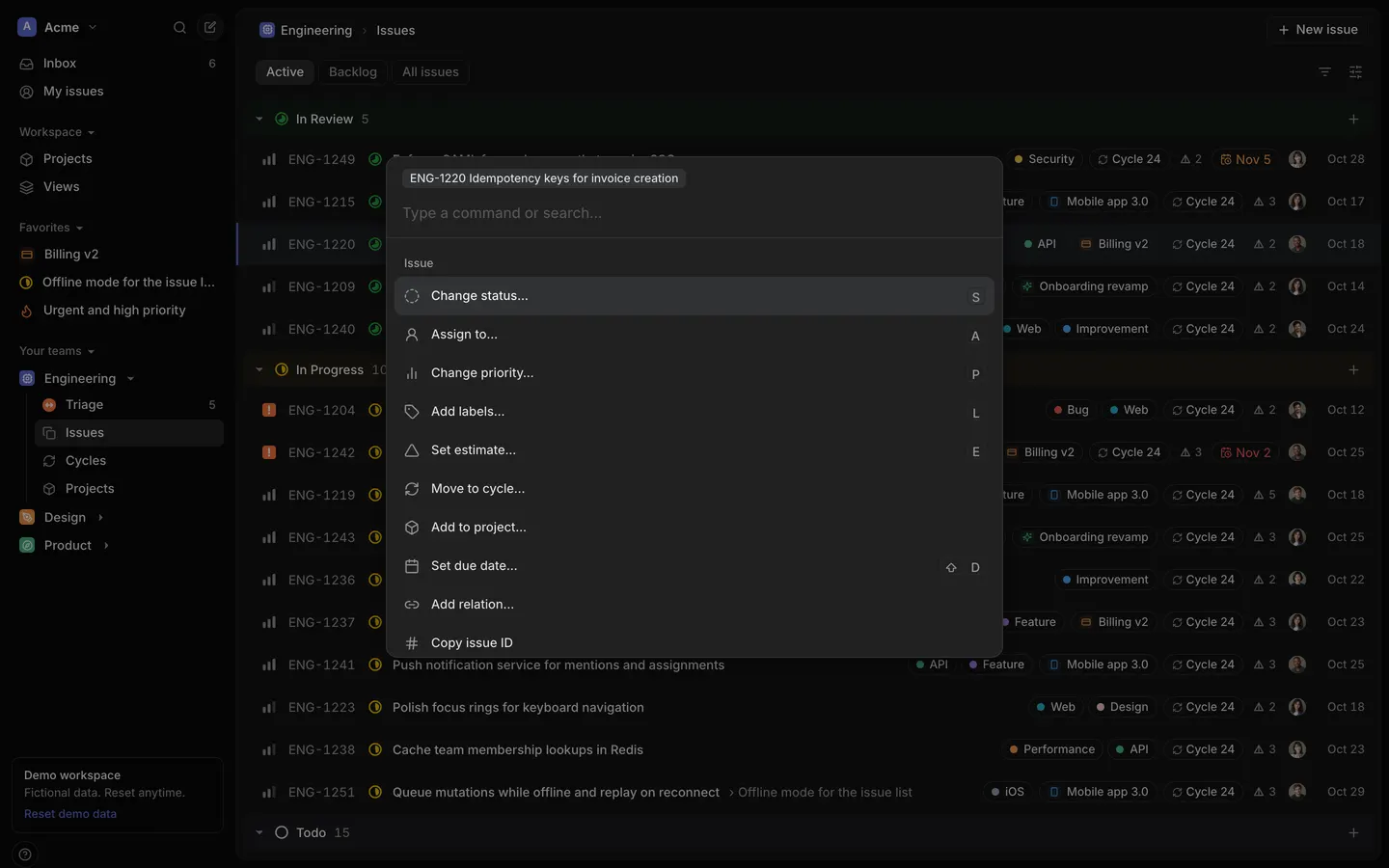
Linear Clone
WebLinear, rebuilt with a working ⌘K, J/K and S/P/A shortcuts, a drag-and-drop board and cycle burn-up charts.
- View template
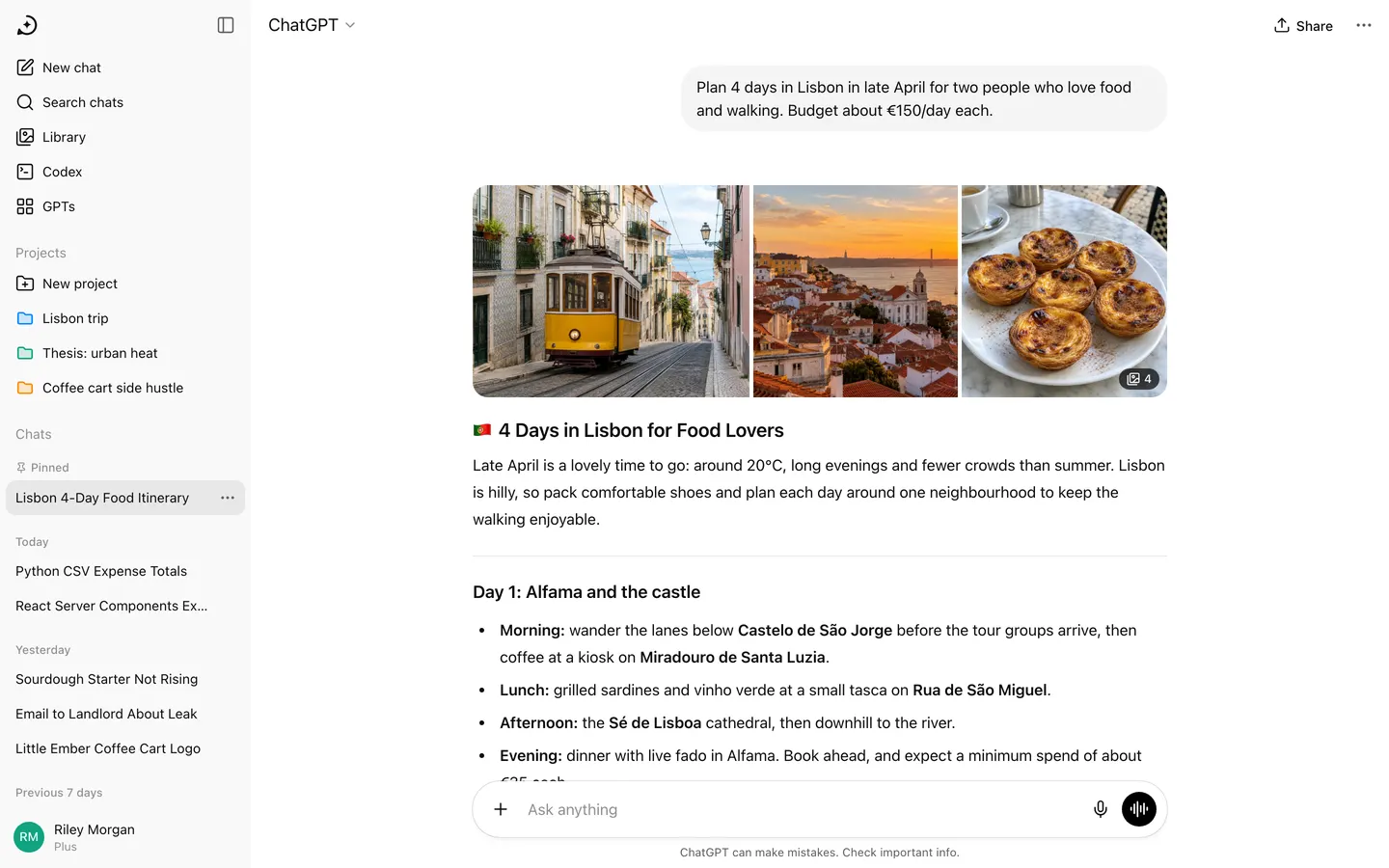
ChatGPT Clone (Web)
WebChatGPT's web app with a real AI inside: streamed answers, code blocks, image generation and PDF summaries.
- View template
Notion Clone
WebNotion with a working block editor, / menu, inline comments, page history and four live database views.
- View template
Ellipsus
iOSEllipsus's new writing app: a painted My work home, live word count, GIF replies, red and green diffs, Merge.